
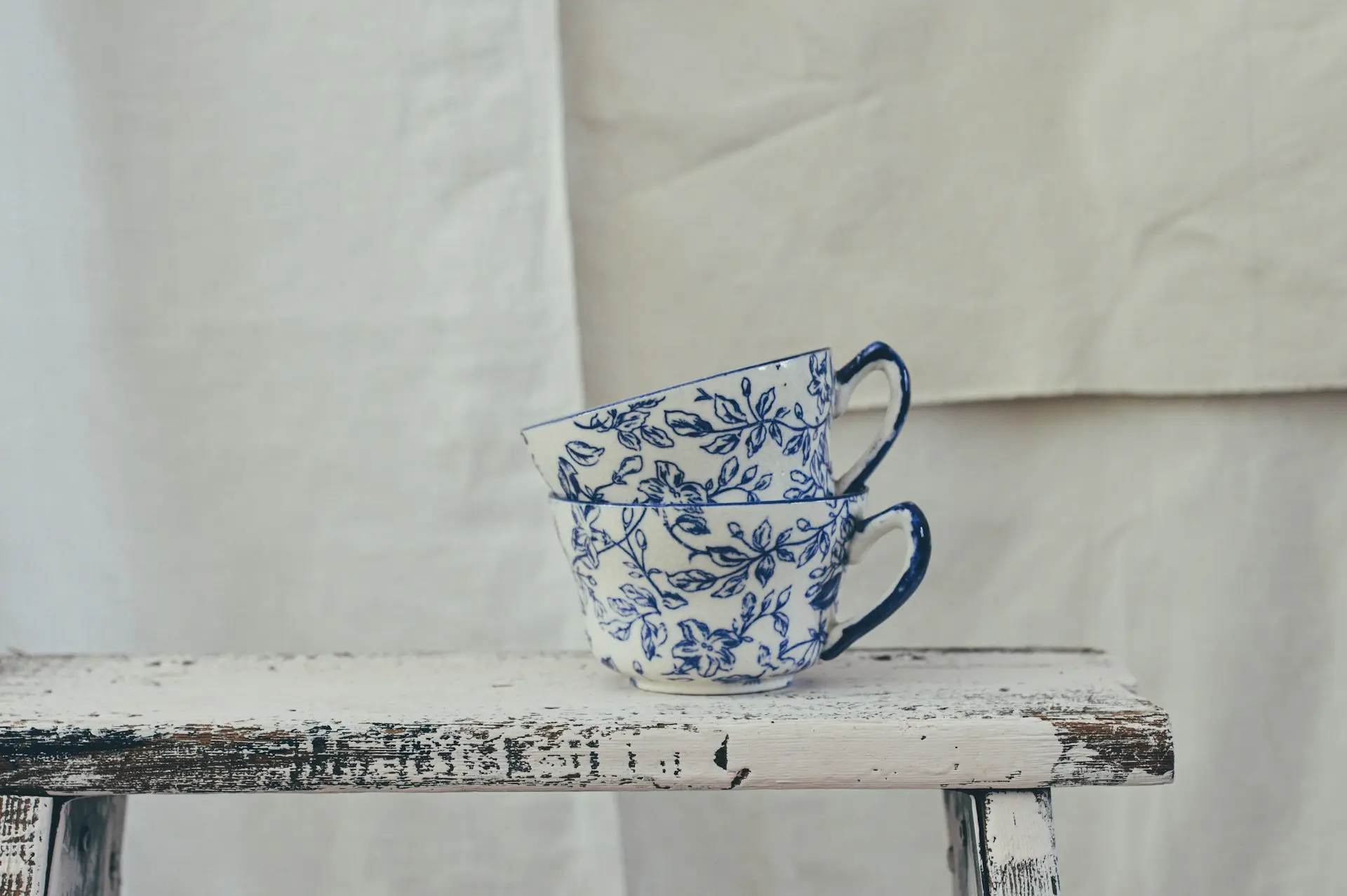
From Hand-Painted Artistry to Industrial Revolution
In the world of antique fine ceramics, there is nothing quite as intricate or enduring as transferware. These uniquely detailed pieces, with their signature look, attract collectors and home designers alike.
At Porcelain Vignette, we believe that understanding the history behind these pieces enriches the ownership experience. What is it that makes transferware so special? The answer lies in the revolutionary technique that democratized sophisticated design and made art accessible to the Victorian home.
The Birth of an Innovation
Before the era of industrialized production, every pattern on a ceramic piece had to be painted by hand—a painstaking, time-consuming, and expensive process that limited fine tableware to the wealthiest European classes.
The invention of transferware, around the 1750s in England, changed everything. The process involved engraving a pattern onto a copper plate, inking the plate with ceramic color (most commonly cobalt blue, but also manganese brown, iron-oxide red, and chrome green), and then pressing a piece of special tissue paper onto the design. This paper, holding the damp, precisely engraved image, was then transferred onto the pre-fired, glazed ceramic body. Once fired at high heat, the pattern fused with the glaze, creating a permanent, stunning replica of the engraving.
This innovation was the ceramic equivalent of the printing press, allowing manufacturers to mass-produce detailed, sophisticated patterns at a fraction of the cost.
The Reign of Romance: Patterns and Popularity
Transferware reached its zenith of popularity during the 19th-century Victorian era. The patterns produced during this period were deeply reflective of the cultural tastes and influence of the British Empire at the time:
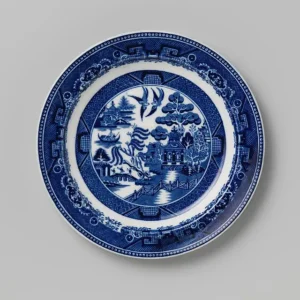
The Willow Pattern:
The undisputed king of transferware. This instantly recognizable pattern—featuring a weeping willow, three figures on a bridge, and a pagoda—is a romanticized Chinese landscape. Despite its widespread association with Asia, the Willow pattern was entirely a Western, English creation, capitalizing on the popular Chinoiserie trend.
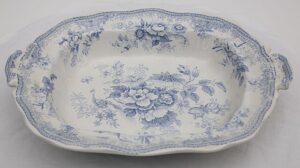
Asiatic Scenes:
Beyond the Willow, popular motifs depicted exotic, often fanciful, scenes of foreign lands, including temples, boats, and distant flora. These patterns satisfied the Victorian appetite for the exotic and the picturesque.
Pastoral and American Views:
As the century wore on, patterns evolved to include local English pastoral settings, historical events, and even detailed “American Views” specifically targeted for export to the rapidly growing United States market.
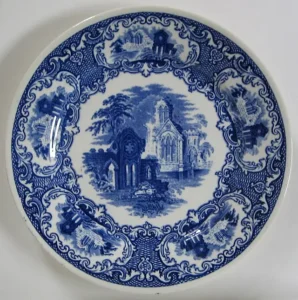
The deep blue coloring—often sourced from ground cobalt oxide—remained the signature look, providing a vibrant, clear contrast that has proved incredibly resilient to the passage of time.
A Mark of Industrial Elegance
The shift to transferware production had a profound effect: it moved ceramic production from a pure artisan craft to an industrial, factory-based operation, particularly centered in the Staffordshire region of England.
This technique solidified the dominance of major manufacturers like Spode, Wedgwood, and Minton, whose ability to meet global demand defined the era.
While a hand-painted piece might be considered more unique, the transferware technique allowed for a consistency and complexity in design that was previously unattainable. Each plate or cup became a small piece of printmaking art, bringing intricate, miniature engravings into the everyday dining room.
This legacy is what we celebrate today. When we hold a piece of transferware, we are holding more than just a dish; we are holding a tangible link to the Industrial Revolution and a pattern that has defined home elegance for over 200 years.
Sources for Further Exploration
Here are some interesting reads if wish to delve deeper into the rich history of ceramic artistry and the specifics of transferware production:
- The Transferware Collectors Club: An excellent online resource providing historical data, pattern identification, and background on specific manufacturers.
- The Victoria and Albert Museum (V&A): Holds one of the world’s most comprehensive collections of British ceramics.
Begin Your Own Transferware Story
You’ve explored the history of these industrial masterpieces. We invite you to continue the journey by curating your own collection. Browse our elegant selection of pieces, each one carrying a tangible link to the Victorian era.
Leave a Reply